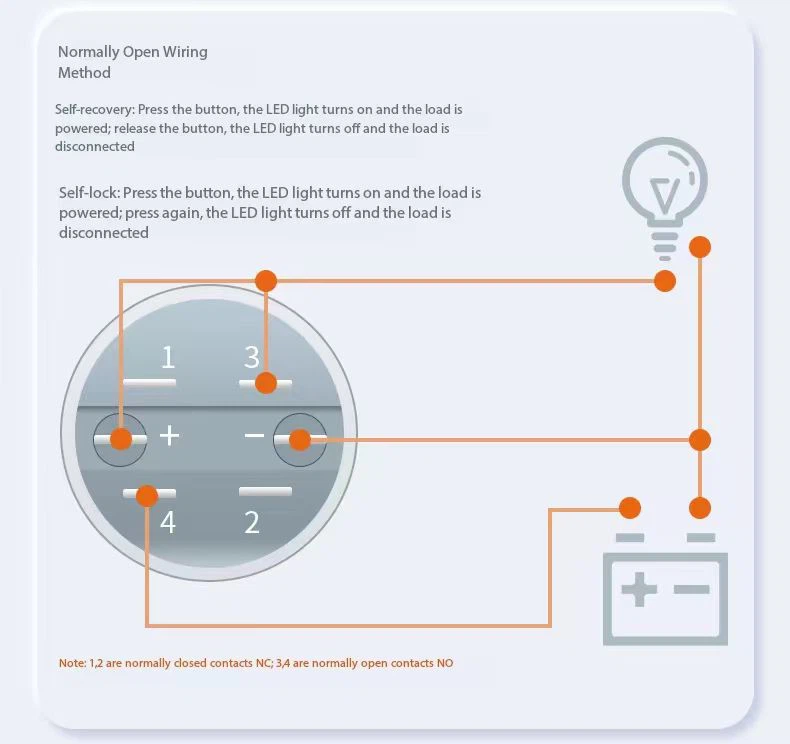

Pushbutton switches are among the most common basic components used in electronic devices and control systems. Their internal contact configuration and pin count directly affect functionality, wiring methods, and application scope. To help users clearly distinguish between different types of switches in practical applications, we provide a systematic explanation of common contact configurations available on the market, enabling quick and accurate product selection.
2-Pin Pushbutton Switches
2-pin switches feature the most basic structure with only two terminals, available in normally open (NO) and normally closed (NC) versions. A normally open switch remains open when idle and closes when pressed. A normally closed switch remains closed when idle and opens when pressed. With a simple structure and economical cost, these switches are ideal for basic on/off control in simple circuits.
3-Pin Pushbutton Switches
3-pin switches use a single-pole double-throw (SPDT) design. They include one common pin, paired with one set of normally open and one set of normally closed contacts. The common terminal serves as the main input, allowing switching between NO and NC states. This design offers greater flexibility than 2-pin switches and is widely used in daily applications.
4-Pin Independent Switches
4-pin independent switches consist of two separate contact circuits: one pair for normally open operation and the other pair for normally closed operation. The two circuits are fully independent with no shared common terminal, allowing separate control of two different circuits. They are suitable for applications requiring independent triggering and control.
4-Pin Double Parallel Switches
Also 4-pin, these switches contain two sets of simultaneously operating contacts, available in double NO or double NC configurations. Both sets actuate at the same time, enabling synchronized dual-circuit control. They are commonly used in control systems requiring redundancy, dual output, or safety protection.
6-Pin Pushbutton Switches
6-pin switches support multi-channel independent control. They integrate two complete NO-NC contact sets with independent common terminals, providing fully isolated dual-circuit control. Each contact set operates independently without interference, making them suitable for industrial control, machinery, and other complex multi-circuit systems.
4-Pin Dual-Control Composite Switches
This 4-pin compact switch integrates two sets of NO and two sets of NC contacts within a small form factor, allowing simultaneous dual-circuit on/off control. Combining compact size and versatile functionality, it is widely used in home appliances, automotive electronics, smart devices, and other space-sensitive applications.
Different pin and contact configurations correspond to different control requirements. Understanding these structural differences allows for more precise product design, wiring, and switch selection, ultimately improving the stability and reliability of equipment.