



Metal Buzzer
Your Professional Metal Buzzer Supplier
We are a manufacturer of all kinds of pushbutton switches. From the factory - direct to the hands of consumers, here we save (total distribution-wholesalers-stores) and other channels, for you to provide a simple direct and effective supply! Besides our existing molded products, YongYuan also can production of products according to the drawings or samples from our customers.


Why Choose Us
24-Hour Service
Our dedicated 24-hour online support ensures prompt responses, providing you with an excellent shopping experience. Feel free to reach out with any questions at any time.
Professional technical support
We have an experienced technical team that can provide comprehensive technical support from product design and process optimization to maintenance.
Our Certificate
Under the strict management of ISO9001 quality system, environmental system ISO14001, the company's products have passed a series of international standard certificates such as UL, VDE, CCC, CE (LVD), CE (EMC).
Customized solutions
Every customer is unique, which is why we offer tailored solutions to meet your specific requirements. We offer technical support that is second to none.We take pride in our rapid response and flexibility to ensure your needs are met.
Advantages of Metal Buzzer

Weather and temperature resistance
A metal buzzer can withstand a broader range of temperatures without warping, cracking, or degrading, making it suitable for outdoor and high-temperature industrial environments where plastic would fail.

Protection against impact and corrosion
A metal housing is more resistant to physical wear and tear, including impacts, vibration, and damage from chemicals. Aluminum and stainless steel are also corrosion-resistant.

Improved security
The strength of a metal enclosure makes it harder to tamper with or damage, which is crucial for security systems and alarms.
Product Paramenters
|
Mounting Hole |
22mm |
|
Crust Material |
Stainless steel |
|
Contact Rating |
40mA, 220V |
|
Sound Intensity |
≥85 dB (0.1m) /≥75 dB (1m) |
|
Phonation Type |
Flicker buzzer |
|
Contact Resistance |
≤50 mΩ max |
|
Insulation Resistance |
≥1,000 mΩ |
|
Dielectric Strength |
2,000V AC |
|
Operating Temperature |
-25℃~+55℃ |
|
IP Class |
IP67 |
|
LED Color |
Red, Green, Blue, Yellow, White. |
Metal Buzzer Types
Passive Buzzer
This type of module generates sound through the vibration of a rotating magnetic field within a coil. It requires an external driver circuit and does not produce sound directly.
01
Active Buzzer
They have an integrated driver circuit and can operate directly with a sound signal. They are often more user-friendly due to the built-in driver circuit.
02
Piezo Buzzer
They produce sound by applying voltage changes to a piezoelectric crystal. They are widely used due to their small size and low power consumption.
03
Electromechanical Buzzer
They produce sound using the magnetic field of an electromagnet instead of the vibration of a coil. They can produce larger and more powerful sounds.
04
Sirens
Sirens are a specialized type of it used in emergency or fire alarm systems. They can generate very high sound levels and are powerful enough to be heard from a distance.
05
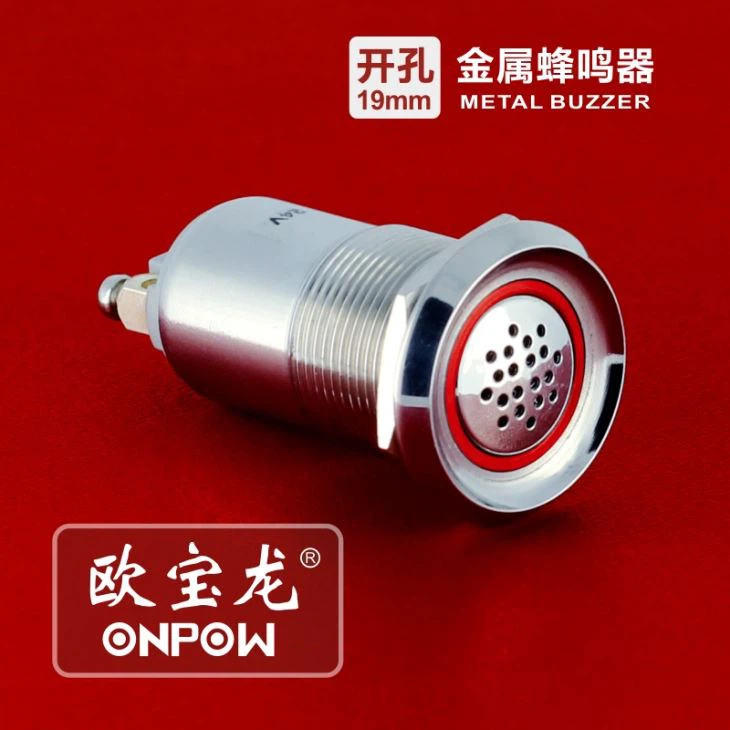
How does Metal Buzzer work
A Metal Buzzer is a simple device that can produce basic beeps and sounds. They work by using piezoelectric crystals, which are special materials that change shape when voltage is applied. If the crystal is pushed toward the diaphragm like a tiny speaker cone, it will generate a pressure wave, which the human ear will pick up as sound. Frequency ranges of 2kHz to 4kHz are most easily heard by human beings, and most Metal Buzzer are designed in this frequency range. Just change the frequency of the voltage sent to the piezo and it will start to produce sound by quickly changing its shape.
Metal Buzzer have two technologies. The first type is node support method. It is to fix the Metal Buzzer of the piezo buzzer in a ring structure approximately the same size as the diameter of the ceramic piece. If the resonant cavity is properly designed, being matched with the correct frequency of the feedback buzzer and the positive feedback circuit, then the correct frequency and greater sound pressure can be generated. The node support method is pupular in self-drive buzzers.
The second type is edge support method. It is to fix the edge of the outer diameter of the buzzer of the Metal Buzzer in the resonant cavity. This method is generally a non-feedback buzzer, and it must be matched with the frequency of the resonant cavity to have a relatively high sound pressure output. An external oscillator circuit must generate a driving signal to make the buzzer sound.
Alarm Systems: They can be utilized to provide audible alarms in burglar alarm systems or fire alarm systems.
Clock and Timer Alarms: A clock or timer project created with Arduino or Raspberry Pi can incorporate it to sound an alarm at a specific time.
Music and Melody Playback
Their sounds can be utilized for simple music and melody playback projects, with the ability to program specific notes or music.
Automation and Control Systems
They can be integrated into automation projects or to indicate when specific events occur.
Education and Learning Projects
They are exceptional components for individuals seeking to learn fundamental electronics and coding concepts. They can aid students in comprehending topics such as basic music theory and frequency control.
FAQ
We're professional metal buzzer manufacturers in China, providing customized metal buzzer for sale. Feel free to wholesale metal buzzer and get quotation from our factory.