


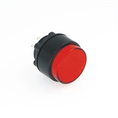

How Are OEM Push Buttons Manufactured? ONPOW Explains
OEM push buttons may look simple, but the production process involves multiple precise steps. From design to final shipment, each stage affects product quality, stability, and service life.
1. Requirement Confirmation and Design
Everything starts with customer requirements, such as:
Panel cutout size (16mm / 19mm / 22mm, etc.)
Electrical rating
Function type (momentary or maintained, illuminated or non-illuminated)
IP protection level (IP65, IP67, etc.)
Logo or custom marking requirements
Based on these details, the engineering team defines the structure and model solution.
2. Material Selection
Material choice is critical for performance and durability:
Stainless steel or nickel-plated metal housing
Engineering plastics for insulation parts
Silver alloy contacts for stable conductivity
Rubber or silicone seals for waterproof models
Different applications require different material combinations.
3. Component Manufacturing
Each part is produced separately with precision processes:
Metal parts: stamping, machining, or CNC processing
Plastic parts: injection molding
Springs and contact parts: forming and heat treatment
All components are controlled within strict dimensional tolerances.
4. Surface Treatment and Marking
To improve durability and appearance, surface finishing is applied:
Polishing or brushing for metal parts
Nickel plating or anti-corrosion treatment
Laser marking for logos, symbols, or text
OEM branding is usually completed at this stage.
5. Assembly
All components are assembled in production lines, including:
Actuator (button head)
Contact module (NO/NC structure)
Spring mechanism
LED module (for illuminated types)
Sealing parts (for waterproof models)
Assembly quality directly affects operation feel and lifespan.
6. Testing Process
Each batch goes through strict testing before release:
Electrical continuity test
Contact resistance test
Operating force test
Insulation test
Waterproof test (for IP-rated models)
Only products that pass all tests can move to the next stage.
7. Final Inspection and Packaging
Before shipment, products are checked again for appearance, function, and labeling accuracy. After confirmation, they are packaged according to customer requirements, including OEM branding or private labels.
Conclusion
OEM push buttons are not just simple assembled parts-they go through a complete manufacturing process involving design, material selection, precision machining, assembly, and testing.
ONPOW focuses on stable production processes and customized solutions, helping customers develop reliable push button products that meet both technical and branding needs.