


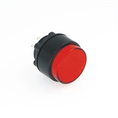

Choosing a push button switch is not always as easy as it looks.
A customer may know the button size they want, but then comes the next question: metal or plastic? Momentary or latching? With LED or without? What IP rating? What voltage and current?
These details can make a difference once the switch is installed on a machine.
At ONPOW, we normally suggest looking at the application first. The right push button is not necessarily the one that looks the best. It is the one that fits the equipment and the way it will be used.
Where will the button be used?
This is usually the first thing to consider.
A push button for an indoor control panel does not have the same requirements as one installed on outdoor equipment.
For industrial machines, customers often pay more attention to durability and operating life. For outdoor equipment, protection against water and dust can be more important. On a control panel, an illuminated button may make it easier for the operator to see the equipment status.
So before choosing a model, it helps to think about the actual working environment.
Metal or plastic?
Both are widely used, but they are used for different reasons.
Metal push buttons are often chosen for industrial equipment because they feel solid and can withstand frequent operation. Stainless steel versions are also popular where appearance and corrosion resistance matter.
Plastic buttons are lighter and can be a more economical choice for many applications. They are also useful when electrical insulation is an important consideration.
There is no simple answer that metal is always better than plastic. It depends on the equipment.
What size do you need?
This is an easy point to overlook.
Common panel sizes include 16mm, 19mm, 22mm and 25mm. If you are installing a new control panel, you have more flexibility. If you are replacing an existing button, the panel cutout needs to be checked first.
A button that is only a few millimeters different may not fit the existing panel.
Momentary or latching?
This depends on what you want the button to do.
With a momentary push button, the contact changes when you press the button and returns when you release it. This type is commonly used for start, stop and control signals.
A latching button stays in its new position after being pressed. It can be useful when the switch needs to remain in a particular state.
This is one of the specifications we recommend confirming before ordering.
What about voltage and current?
The electrical rating should match the circuit.
Customers sometimes focus mainly on the appearance and mounting size, but the electrical specifications are just as important. Voltage, current, AC or DC, and contact configuration all need to be considered.
For some applications, the push button is only sending a control signal to a PLC or relay. In other applications, the electrical requirements may be different.
Do you need an illuminated button?
Not every machine needs one.
But if operators need to know whether a machine is running, stopped, selected, or in alarm condition, an illuminated push button can be useful.
ONPOW offers different LED colors and illumination styles, including ring illumination. The choice usually depends on the control panel design and the information the operator needs to see.
Don't forget the IP rating
If the button will be exposed to water, dust, oil or outdoor conditions, check the IP rating before making a decision.
IP65, IP67 and IP68 are not the same. The required level depends on the actual environment.
For example, a button used inside a clean control cabinet may not need the same protection as one installed on outdoor equipment.
What if you still don't know which one to choose?
This happens quite often.
Some customers send us a photo of their control panel, the panel cutout size, voltage and current requirements, and tell us where the equipment will be used. From there, it is much easier to recommend a suitable switch.
This is also why we don't think choosing a push button should be based on a product photo alone.
ONPOW has been manufacturing push button switches since 1988. Our range includes metal and plastic switches, different mounting sizes, illuminated options and different protection levels.
If you are not sure which push button switch is suitable for your equipment, send us the application details. We can look at the requirements first and then recommend a suitable option.