


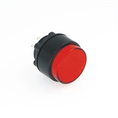

When buying switches for industrial equipment, it is quite common for customers to ask about push buttons and key switches at the same time.
They can both be installed on a control panel. They can both be used to control a machine. And from a distance, they may not look very different.
But they solve different problems.
At ONPOW, we have been making push button switches since 1988. When customers send us an inquiry, we don't normally start by asking which product they want.
We first ask what they need the switch to do.
That usually tells us whether a push button, key switch, or another type of switch is the better choice.
Push Button: Simple and Easy to Operate
A push button is mainly used when the operator needs to give the machine a command.
Press the button and the circuit changes.
For a momentary button, release it and the button returns to its original position.
This is why push buttons are commonly used for:
START
STOP
RESET
Trigger functions
Manual operation
Control signals
Think about a production machine.
An operator may need to press the START button several times during a working shift. Using a key every time would not make much sense.
A push button is quicker, simpler and easier for regular operation.
This is one reason push buttons are so common on industrial control panels.
Key Switch: When Operation Needs to Be Restricted
A key switch is different because the key itself becomes part of the operation.
Without the key, the operator normally cannot change the switch position.
This can be useful when a particular machine function should not be changed by everyone.
For example, a machine may have:
AUTO / MANUAL
Normal operators may use the machine in automatic mode, while a maintenance technician may need to switch it to manual mode.
A key switch can be used for this type of function.
It is also seen in equipment where the manufacturer wants to reduce unauthorized operation or accidental changes.
In these situations, the key isn't there just for appearance.
It controls access to the function.
Which One Should You Use?
This is where the difference becomes easier to understand.
If the operator needs to press the switch regularly, a push button is usually more convenient.
If the function needs some form of access restriction, a key switch may make more sense.
For example:
| Machine function | Common choice |
|---|---|
| START | Push button |
| STOP | Push button |
| RESET | Push button |
| Alarm reset | Push button |
| AUTO / MANUAL selection | Key switch |
| Restricted machine operation | Key switch |
| Maintenance mode | Key switch |
This is not a fixed rule for every machine. The control circuit and safety requirements still need to be considered.
A Key Switch Is Not Simply a "Push Button With a Key"
This is a misunderstanding we sometimes see.
Adding a key to a switch changes the way the operator interacts with the equipment.
A standard push button is generally about quick control.
A key switch is often about controlled access.
That's why replacing one with the other is not always as simple as checking whether they have the same mounting size.
The electrical contacts, switching method, mounting dimensions and operating function all need to match.
What If the Machine Uses Both?
There is no reason a control panel has to use only one type.
In fact, many machines can benefit from using both.
For example:
START / STOP / RESET
can use push buttons because these functions are used regularly.
AUTO / MANUAL
can use a key switch because changing the operating mode may need to be limited.
This gives the operator an easier interface while keeping certain functions under better control.
Don't Mix Up Key Switches and Emergency Stop Switches
Another question we sometimes receive is whether a key switch can be used instead of an emergency stop.
They are not the same thing.
A key switch is mainly concerned with controlling access to a function.
An emergency stop switch is designed for emergency stopping and has specific requirements related to machine safety.
ONPOW produces both types of products, but they have completely different purposes.
The fact that both can be mounted on a machine panel doesn't make them interchangeable.
What About the Electrical Specifications?
The operating method is only part of the selection.
Before ordering, the electrical side still needs to be checked.
For example:
What voltage is being used?
What current does the switch need to handle?
AC or DC?
NO or NC?
How many contacts are required?
Momentary or maintained?
What is the expected operating frequency?
This is especially important when replacing an existing switch.
A customer may say:
"I need the same switch as this one."
But the appearance alone doesn't tell us everything.
A photo is useful, but the electrical specifications and dimensions are still needed before confirming a replacement.
This Is Where Manufacturer Experience Helps
Over the years, ONPOW has received many inquiries that start with a photo, a drawing or an old sample.
Sometimes the customer knows the exact model.
Sometimes they only know that the switch is installed on a CNC machine, packaging machine, control cabinet or other industrial equipment.
That's normal.
You don't necessarily need to know the exact ONPOW model before contacting us.
If you can provide the application, panel cutout, electrical requirements, operating method and a photo of the existing switch, we can start from there.
ONPOW has been manufacturing push button switches since 1988.
Our product range includes metal push buttons, plastic push buttons, illuminated push buttons, emergency stop switches, key lock switches, selector switches, piezo switches and indicator lights.
We also have production capabilities covering tooling, metal parts, plastic parts, stamping and assembly.
For OEM projects, customers can also provide drawings or samples when a standard product does not exactly match the equipment.
What Do Overseas Buyers Usually Care About?
After years of communicating with customers and meeting buyers at overseas exhibitions, we have found that the first question is not always:
"What's the price?"
For many equipment manufacturers, the questions come later:
Will it fit our panel?
Can you keep the same specifications for repeat orders?
Can you provide the same switch for the next production batch?
Can you make changes to the existing design?
Can you support a new project?
These are practical questions for an OEM buyer.
A switch may cost only a small amount compared with the whole machine, but changing the switch after a machine has already entered production can be much more troublesome.
That's why choosing the manufacturer matters as much as choosing the switch.
Push Button or Key Switch?
There isn't one answer for every application.
If the operator needs a simple control that is used frequently, a push button is usually the more practical choice.
If a machine function needs to be restricted to authorized operators or maintenance personnel, a key switch may be more suitable.
And in some machines, the best solution is to use both.
At ONPOW, we don't believe in choosing a switch simply because it is the most popular model.
Tell us what the machine needs to do first.
The right switch usually becomes much easier to identify from there.