


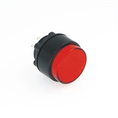

How to Choose a Push Button Switch for Industrial Equipment?
Choosing a push button switch for industrial equipment can look easy at first.
You know the panel size. You know the voltage. You know you need a button.
Then you start looking at suppliers and suddenly there are dozens of choices:
Metal or plastic?
16mm, 19mm, 22mm or 25mm?
Momentary or latching?
NO or NC?
With LED or without?
IP65 or IP67?
For buyers who purchase switches regularly, these specifications are familiar. But for someone buying a push button for a new machine, it can be surprisingly easy to choose the wrong one.
This is something we see at ONPOW quite often.
We have been manufacturing push button switches since 1988. Over the years, customers have brought us drawings, samples and even photos of old switches and asked us to help identify the right replacement.
Usually, the problem isn't that they don't know what a push button is.
They simply don't know which push button is right for their machine.
Start With the Machine, Not the Button
This is probably the simplest advice we can give.
Don't start by looking through hundreds of push button models.
Start with the equipment.
What does the button need to do?
Is it used to start a machine?
Stop a process?
Reset an alarm?
Select a function?
Send a signal to a PLC?
Or is it being used as an emergency stop?
The answer changes the type of switch you need.
For example, a momentary push button may be suitable for a START signal, while a latching switch may be more appropriate when the operator needs the switch to remain in a particular state.
This is why, when a customer contacts ONPOW, we often ask about the application before recommending a model.
Then Check the Electrical Requirements
Once we know what the button is supposed to do, we look at the circuit.
The basic information includes:
Voltage
Current
AC or DC
NO or NC
Number of contacts
Load type
A 24VDC PLC input is not the same application as a button directly switching an AC load.
This sounds obvious to an electrical engineer, but it is one of the details that can easily be missed when purchasing a replacement switch.
ONPOW has different push button series for different electrical requirements. For example, our product range includes small control buttons as well as metal push buttons with different contact and voltage configurations. The exact rating always needs to be checked against the specific model rather than assuming that all push buttons have the same electrical capacity.
Measure the Panel Before Ordering
This is another mistake that happens more often than you might expect.
A customer may say:
"I need a 22mm button."
But does 22mm mean the button diameter or the panel cutout?
Those are not necessarily the same thing.
Before placing an order, measure the existing panel hole and check the panel thickness.
ONPOW produces push buttons in different mounting sizes, including 16mm, 19mm, 22mm and other configurations depending on the series.
If you are replacing an old switch, sending the supplier a photo together with the panel cutout measurement can save quite a bit of back-and-forth.
Metal or Plastic?
This usually comes down to the equipment.
Metal push buttons are often chosen for industrial machinery because they feel solid and give the control panel a more robust appearance.
Stainless steel is particularly popular when the customer wants durability and corrosion resistance.
Plastic buttons have their place too.
For indoor equipment where weight and cost are important, a plastic push button may be perfectly suitable.
At ONPOW, we manufacture both metal and plastic push buttons. We don't tell every customer that metal is automatically better.
A button should match the machine.
That's more important than simply choosing the more expensive material.
What About IP Rating?
If the equipment is used in a workshop, outdoors or in an environment where water and dust are present, IP protection needs to be considered.
You may see specifications such as IP65, IP67 or IP68.
But don't make the mistake of thinking:
Metal button = waterproof button.
It doesn't work that way.
Water resistance depends on the complete construction, sealing and installation of the switch.
For example, ONPOW has IP65/IP67 metal push button products, while some waterproof/piezo series offer higher protection levels for particular applications. The correct model depends on the actual working environment.
Think About How Often the Button Will Be Pressed
A button used five times a day doesn't have the same job as a button on a production line that is pressed throughout every shift.
For industrial equipment, buyers should therefore look at both:
Mechanical life
and
Electrical life
These are not the same thing.
Mechanical life relates to the physical operation of the mechanism.
Electrical life relates to the switching performance of the contacts under specified electrical conditions.
For a machine that will operate for years, this difference matters.
Do You Need an Illuminated Button?
Walk around an industrial control panel and you'll quickly see why illuminated push buttons are popular.
When there are ten or twenty buttons on a panel, a small LED can make it much easier for an operator to understand what is happening.
ONPOW produces illuminated push buttons with different LED colors and configurations, including ring illumination. Depending on the series, customers can select different LED voltage options and button designs.
For some machines, the light is simply an indicator.
For others, it becomes part of the operator interface.
What We Hear From Customers at International Exhibitions
One reason we continue attending overseas exhibitions is that talking to customers face-to-face is very different from simply receiving an inquiry by email.
At exhibitions, buyers often don't start with a technical specification.
They start with the problem.
They might bring an old switch and ask:
"Can you make this one?"
Or:
"We need something like this, but waterproof."
Or:
"Our current supplier has a long lead time. Can you make the same type?"
These conversations are useful because they show us what buyers actually struggle with.
They are not always looking for the cheapest push button.
Quite often, they are looking for a switch that fits the machine, can be supplied consistently and won't create problems later.
That is also why ONPOW has continued to develop its product range rather than focusing on just one type of button.
Why Manufacturing Experience Matters
ONPOW was established in 1988 and has focused on push button switches for more than 30 years.
Today, the company has around 40 push button product series and more than 1,500 molds available for production. ONPOW also develops new product series each year.
For a buyer, those numbers are not important just because they sound impressive.
The practical advantage is flexibility.
A customer may need a standard 22mm metal button.
Another may need a short-body version because there is limited space behind the panel.
Another may need a particular LED configuration.
Another may have a drawing or sample that doesn't exactly match an existing model.
ONPOW's manufacturing capabilities and tooling resources allow us to work with these different requirements, including production based on customer drawings or samples.
What If You Don't Know the Exact Model?
This happens.
And you don't necessarily need to know the model number before contacting a manufacturer.
Send us:
A clear photo of the button
Panel cutout diameter
Panel thickness
Voltage
Current
AC or DC
Contact requirement
Whether it is momentary or latching
IP requirement
Quantity
If you have the original drawing or sample, even better.
This information is usually much more useful than simply saying:
"I need an industrial push button."
Don't Choose a Push Button by Price Alone
Price is obviously important for procurement.
But if the button is going into a machine that will be sold to your own customer, the cheapest component is not necessarily the cheapest choice in the long run.
A switch that doesn't fit properly can cause installation problems.
The wrong electrical rating can shorten contact life.
An unsuitable IP rating can create problems in a wet environment.
And inconsistent dimensions between batches can become a headache for an OEM manufacturer.
This is where having an experienced manufacturer can make a difference.
ONPOW's product range covers metal and plastic push buttons, illuminated buttons, emergency stop switches, selector switches, piezo switches and indicator lights. The company also has production capabilities covering molds, metal parts, plastic parts, stamping and assembly.
For customers who need customized products, ONPOW can work from drawings, samples and specific application requirements rather than limiting the customer to an off-the-shelf model.
The Best Push Button Is the One That Fits the Machine
After so many years in this industry, our view is fairly simple.
Don't choose a push button because it looks good in a catalog.
Don't choose it only because it is cheap.
And don't assume that metal is always better than plastic.
Start with the machine.
What does the button need to do?
Then look at the electrical requirements, panel size, operating environment, frequency of use and expected service life.
Once those things are clear, choosing the right push button becomes much easier.
That is how we approach product selection at ONPOW.
The right push button isn't the one with the most features. It's the one that works properly in your equipment and continues to do so after the machine leaves your factory.