


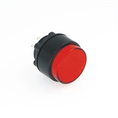

If you are buying switches for a new machine, you may come across three words quite often:
Switch. Toggle. Pushbutton.
They can sound like three completely different products. In fact, there is some overlap between them.
The word "switch" is the general term. A toggle switch and a pushbutton are both types of switches, but they work differently and are used for different control functions.
At ONPOW, we have been making push button switches since 1988. When customers ask us which type they should use, we normally start with one question:
What do you want the operator to do?
That usually tells us more than the product name.
A Switch Is a General Term
A switch is simply a device that controls an electrical circuit.
It can open a circuit, close a circuit, or change the connection between circuits.
Pushbuttons, toggle switches, selector switches and rocker switches are all types of switches.
So if a buyer sends an inquiry saying only "I need a switch," there is still quite a lot to confirm.
The operating method, electrical rating, panel size, contact configuration and installation environment all matter.
How Does a Toggle Switch Work?
A toggle switch normally has a lever.
The operator moves the lever from one position to another, and the switch stays in that position.
For a simple ON/OFF function, this can be very convenient.
You can look at the lever and immediately see whether it is in the ON or OFF position.
Toggle switches are often used on:
Electrical equipment
Control panels
Test equipment
Industrial machinery
Vehicles
Power equipment
If the operator needs to select and maintain a particular position, a toggle switch can be a good solution.
What Makes a Pushbutton Different?
A pushbutton is operated by pressing it.
This sounds simple, but pushbuttons can be configured in quite different ways.
A momentary pushbutton only changes the contact while it is being pressed. Once released, it returns to its normal position.
This is why pushbuttons are commonly used for:
Start
Stop
Reset
Trigger
Manual control
Signal input
For example, an operator presses a START button. The button sends a signal to the PLC, and the PLC controls the machine.
The button itself does not necessarily need to stay pressed.
There are also latching pushbuttons, which remain in their changed position after being pressed.
The choice depends on the control circuit and what the operator needs to do.
Which One Is More Common on Industrial Equipment?
There is no universal answer, but pushbuttons are very common on industrial control panels.
Think about a CNC machine or an automated production line.
An operator may need separate buttons for:
START → STOP → RESET → MANUAL → AUTO
A pushbutton gives the operator a simple and familiar way to send these commands.
For this type of equipment, the button is often connected to a PLC, relay or contactor rather than switching the main machine power directly.
This is one reason electrical specifications matter when selecting a pushbutton.
What About Emergency Stop Buttons?
Emergency stop buttons are a special case.
They may look like large pushbuttons, but they are designed for a specific safety function.
An emergency stop normally latches when pressed and must be intentionally reset.
ONPOW produces emergency stop switches in different designs, including different button sizes, reset methods and contact configurations.
For a machine builder, an emergency stop should be selected according to the machine's safety requirements. A standard momentary pushbutton should not be used as a substitute simply because it fits the panel.
Metal or Plastic Pushbutton?
Once a customer decides to use a pushbutton, we often get another question:
Should it be metal or plastic?
For industrial equipment, metal pushbuttons are popular because they provide a solid operating feel and can give the control panel a more robust appearance.
Stainless steel versions are commonly used where durability and corrosion resistance are important.
Plastic pushbuttons have their own advantages.
They are lighter, generally more economical and can be a good choice for many indoor applications.
ONPOW produces both metal and plastic pushbutton switches because the requirements are different from one machine to another.
We don't think every customer needs a metal button.
If a plastic button does the job well and helps keep the equipment cost under control, it may be the better choice.
Does the Button Need to Light Up?
Sometimes the operator needs more than just a physical button.
They need to know what the machine is doing.
That's where an illuminated pushbutton can be useful.
ONPOW offers illuminated pushbuttons with different lighting designs, including ring illumination, as well as different LED colors and voltage options depending on the product series.
For example, an illuminated button can be used to show that a machine is running, that a function has been selected, or that an operator needs to take action.
The lighting is not just for appearance. On a busy control panel, a clear visual indication can make operation easier.
What Should You Consider Before Choosing?
When we discuss a new button project with a customer, we normally look at a few practical points first.
How is the button going to be operated?
If the operator needs a maintained position, a toggle or latching switch may be appropriate.
If the operator only needs to send a command, a momentary pushbutton may be the better choice.
What is the electrical load?
Voltage, current, AC or DC, contact configuration and load type all need to be checked.
What is the installation environment?
For outdoor equipment or machinery exposed to water and dust, the IP rating becomes important.
How much space is available on the panel?
ONPOW pushbuttons are available in different mounting sizes, including commonly used sizes such as 16 mm, 19 mm, 22 mm and 25 mm, depending on the series.
How often will the switch be used?
A button used several times a day has very different requirements from one pressed continuously throughout a production shift.
Mechanical life and electrical life should therefore be considered together with the application.
Why Do Customers Work With ONPOW?
For a small component like a pushbutton, it can be tempting to compare suppliers only by unit price.
That can work for a simple one-time purchase.
For equipment manufacturers buying the same switch for years, things are a little different.
They need consistent dimensions.
They need stable electrical performance.
They need the same specifications from one production batch to the next.
And when a standard product does not fit the machine, they need a manufacturer that can discuss a solution rather than simply saying, "We don't have it."
ONPOW has been manufacturing push button switches since 1988.
Over the years, our product range has expanded to include metal pushbuttons, plastic pushbuttons, illuminated switches, emergency stop switches, selector switches, piezo switches and indicator lights.
We also have production capabilities covering molds, metal components, plastic components, stamping and assembly.
For OEM projects, customers can provide drawings, samples or detailed application requirements. From there, we can work on the appropriate product configuration.
So, Which One Should You Choose?
If you need a maintained ON/OFF position that is easy to see, a toggle switch may be the right choice.
If you need a simple command such as START, STOP or RESET, a pushbutton is often more suitable.
If the equipment needs emergency shutdown, use a properly designed emergency stop switch.
And once you have decided on a pushbutton, you still need to choose the right size, material, contact arrangement, electrical rating, illumination and IP protection.
That's how we approach switch selection at ONPOW.
Don't start with "Which switch is better?"
Start with:
"What does my equipment need the operator to do?"
Once that is clear, choosing the right switch becomes much easier.