


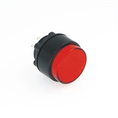

When choosing a push button switch, voltage and current are usually two of the first specifications buyers look at.
But these two numbers can be easy to misunderstand.
A push button rated for 250VAC is not automatically suitable for a 250VDC application. A switch designed for a small PLC signal is also not the same as a switch used to control a larger electrical load.
After more than 30 years of making push button switches, this is one of the questions we hear regularly from equipment manufacturers and purchasing teams.
So, what should you actually look at?
Voltage Rating: What Does It Tell You?
The voltage rating indicates the voltage that the switch contacts are designed to handle under specified conditions.
Depending on the product, you may see ratings such as:
12VDC
24VDC
110VAC
125VAC
220VAC
250VAC
The important thing is that the rating belongs to a specific switch design.
At ONPOW, different push button series have different electrical specifications. For example, some of our compact push buttons are designed for low-voltage control circuits, while other series are intended for different industrial control applications.
This is why we normally ask customers about the actual circuit before recommending a product.
Current Rating Is Just as Important
Voltage is only half of the picture.
The current rating tells you how much current the switch contacts are designed to carry or switch under specified conditions.
A specification such as:
3A 250VAC
needs to be understood as a complete rating. It does not mean that the same switch can simply be used at 3A and 250VDC.
The actual electrical life also depends on the load and how often the switch is operated.
For a machine manufacturer buying thousands of switches, this can be more important than the initial unit price.
AC and DC Ratings Are Different
This is one of the most common mistakes we see when customers select switches.
AC and DC loads behave differently when mechanical contacts open.
With DC, the arc does not naturally pass through zero in the same way as AC. Because of this, a switch may have different ratings for AC and DC.
So if your equipment operates at 24VDC, tell the manufacturer that it is 24VDC, rather than simply saying "24V".
It sounds like a small detail, but it can make a difference when selecting the contact system.
A 24VDC Push Button Is Common in Industrial Equipment
24VDC is widely used in industrial control systems.
You can find it in:
PLC control systems
Automation equipment
CNC machines
Packaging machinery
Robots
Sensors and control circuits
Industrial control cabinets
In many of these applications, the push button is not switching the main power of the machine.
Instead, the circuit may look something like:
Push button → PLC / relay / contactor → machine
The button sends a control signal, while the relay or contactor handles the larger load.
This is one reason we always ask how the button will be used before selecting the electrical specification.
What About 220–250VAC?
Some push button switches are designed for higher-voltage AC control applications.
But again, the exact rating depends on the product.
A buyer should check:
Rated voltage
Rated current
AC or DC
Contact configuration
Load type
Electrical life
For example, a resistive load and an inductive load can place different demands on the contacts.
If the switch will control a relay, motor, solenoid or other inductive load directly, it is worth discussing the application with the manufacturer rather than selecting a switch from one number on a catalog page.
Don't Forget the LED
Illuminated push buttons have another specification that buyers sometimes overlook.
The LED voltage and the switch contact rating are two different things.
For example, a push button may have contacts used in one circuit while the LED operates from a separate low-voltage supply.
ONPOW offers illuminated push buttons in different configurations, including ring illumination and different LED voltage options depending on the series.
For equipment manufacturers, this makes it possible to match the button to the control voltage and the appearance of the panel at the same time.
What Happens If You Choose the Wrong Rating?
A switch can still appear to work when it is being used outside its intended rating.
The problems may show up later.
Depending on the application, an incorrect electrical rating can lead to:
Faster contact wear
Arcing
Contact welding
Shorter electrical life
Heat generation
Intermittent operation
For production equipment, this is not something you want to discover after the machine has been shipped to a customer.
That is why electrical specifications should be confirmed before ordering.
What Information Should You Send to a Push Button Manufacturer?
When asking for a quotation, simply saying "24V push button" is usually not enough.
A manufacturer will get a much clearer picture if you provide:
Electrical information
Operating voltage
Current
AC or DC
Load type
Switch requirements
NO / NC
Momentary or latching
Number of contacts
Electrical life
Mechanical requirements
Panel cutout
Button size
Panel thickness
Terminal type
Environmental requirements
IP rating
Operating temperature
Outdoor or indoor installation
Vibration or other special conditions
Appearance
Metal or plastic
Button color
LED or non-illuminated
Ring illumination or point illumination
The more information the manufacturer has, the less chance there is of choosing the wrong model.
How ONPOW Handles Different Applications
ONPOW has been manufacturing push button switches since 1988.
Over the years, the product range has expanded from standard push buttons to metal push buttons, plastic push buttons, illuminated switches, emergency stop switches, selector switches, piezo switches and other control components.
The company has more than 40 product series and a large range of tooling and product configurations, allowing customers to select different sizes, materials, contact arrangements, illumination options and protection levels.
For example, ONPOW's metal push button range includes stainless steel and other metal designs for equipment where durability and appearance are important.
For applications where water and dust protection are required, selected models are available with higher IP protection levels.
For control panels where visual feedback is useful, illuminated versions are available in different configurations.
The point is not to use the same switch everywhere.
Different equipment needs different switches.
Manufacturing Matters Too
For buyers, the electrical specification is only one part of the decision.
When ordering 5,000 or 50,000 pieces, consistency between batches becomes important.
ONPOW has its own manufacturing capabilities covering areas such as molds, metal components, plastic components, stamping and assembly.
This gives the company more control over the production process instead of relying entirely on outside suppliers for every component.
ONPOW also operates under ISO9001, ISO14001 and ISO45001 management systems, with products carrying certifications and approvals for different markets and applications.
For international buyers, this matters because a push button is usually a small component, but a problem with that small component can affect the entire machine.
What We Recommend
There is no single voltage or current rating that is suitable for every push button switch.
A 24VDC control circuit, a 250VAC control circuit and a high-frequency industrial application all need to be considered differently.
If you are selecting a push button for a new project, start with four things:
Voltage + Current + AC/DC + Load
Then look at the mechanical size, contact configuration, IP rating, illumination and operating conditions.
At ONPOW, we manufacture both standard and customized push button switches for equipment manufacturers and distributors in different markets.
If you have a drawing, sample, existing switch or simply the electrical requirements of your equipment, it is usually enough for us to start discussing the right solution.
A push button may be a small part of a machine, but choosing the right electrical rating is not a small matter.