


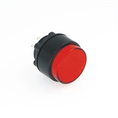

When buying push button switches, many customers start with the same question:
Metal or plastic?
It sounds like a simple choice, but the answer usually depends on where the switch will be installed and how the equipment will be used.
ONPOW has been making push button switches since 1988. We produce both metal and plastic switches, and we have customers using them in everything from control panels and machinery to charging equipment and automation systems.
So which one should you choose?
Metal Push Button Switches
Metal push buttons are a common choice for industrial equipment.
Stainless steel is often used when the switch needs to withstand regular handling, while aluminum and other metal finishes are also used for different equipment designs.
One thing users notice right away is the feel.
A good metal push button feels firm when pressed. For a machine that is operated hundreds or thousands of times during its service life, this can make a difference.
Metal switches are also popular when the control panel needs a more robust appearance.
You will often find them on:
Industrial machinery
CNC equipment
Automation systems
EV charging stations
Control panels
Outdoor equipment
Energy equipment
For outdoor use, however, the fact that a switch is made of metal does not automatically make it waterproof. The actual IP rating and sealing design still need to be checked.
Plastic Push Button Switches
Plastic switches have their own advantages.
They are lightweight, generally more economical, and suitable for many indoor control applications.
For equipment manufacturers ordering thousands of switches, cost can be an important consideration. If the machine is installed in a relatively clean and dry environment, there may be little reason to pay extra for a metal switch.
Plastic is also a good electrical insulating material and can be molded into different shapes and designs.
This is why plastic push buttons are still widely used in electrical equipment, control panels, machinery and other applications.
Choosing plastic does not mean choosing a lower-quality product.
The right plastic material and switch construction can provide reliable performance for the intended application.
Metal or Plastic? Look at the Application
Here is how we normally look at it.
If the equipment is used outdoors, operated frequently, or needs a stronger and more substantial control panel, metal is often worth considering.
If the equipment is indoors, weight and cost are more important, and the working environment is relatively clean, plastic may be the more practical option.
There is also the appearance of the equipment.
For a high-end control panel or commercial product, a stainless steel button can give the finished product a different look and feel.
For an internal machine panel where appearance is not important, a plastic button may make more sense.
What About Durability?
This is where buyers sometimes make a mistake.
It is tempting to assume:
Metal = long life
Plastic = short life
It is not that simple.
The service life of a push button depends on much more than the outer material.
The contact system, spring mechanism, internal construction, operating force, electrical load and manufacturing quality all matter.
A well-designed plastic switch can last a long time in the right application.
Likewise, a metal switch will not perform well if the electrical rating or installation conditions are wrong.
What Should You Check Before Ordering?
Before sending a purchase order, we recommend checking a few basic points.
Panel cutout
Make sure the mounting size matches the panel. Common sizes include 16 mm, 19 mm, 22 mm and 25 mm.
Electrical rating
Check the actual voltage and current requirements rather than selecting a switch based only on its appearance.
Contact configuration
Determine whether you need NO, NC, or a combination of both.
Operation
Do you need a momentary switch that returns after release, or a latching switch that stays in position?
IP rating
If the equipment is exposed to water or dust, check the actual IP rating of the model.
Material
For metal switches, stainless steel, aluminum and other materials can have different characteristics and costs.
Illumination
If the operator needs to see the machine status clearly, an LED or ring-illuminated version may be useful.
Why Does ONPOW Make Both Metal and Plastic Switches?
Because our customers do not all build the same equipment.
A CNC machine, an EV charger and an indoor control cabinet can have completely different requirements.
Recommending a metal switch simply because it costs more does not make sense.
The same is true for choosing plastic only because it is cheaper.
At ONPOW, we offer both metal and plastic push button switches in different sizes and configurations. Customers can choose according to the equipment, installation environment and electrical requirements.
For OEM projects, we can also discuss product customization based on drawings, samples and specific application requirements.
After more than 30 years in the push button industry, this is something we have learned:
The best push button is not the most expensive one. It is the one that works reliably in the equipment it was designed for.
If you are deciding between a metal and plastic push button for a new project, start with the working environment and electrical requirements. The material choice usually becomes much easier after that.