


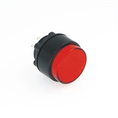

When customers ask us about push button switches, they usually start with the same questions: What is the voltage? What is the panel cutout? Is it waterproof? How long will it last?
The material of the button cap is often discussed later.
But the cap is actually one of the parts users touch most often. Its material affects the look and feel of the switch, and in some applications, it also matters for durability.
So, what materials are commonly used for push button caps?
Plastic Is Still Widely Used
Plastic caps are common in many push button switches.
Materials such as PC, PA and ABS can be used depending on the switch design and application.
One reason is simple: plastic gives manufacturers more flexibility. It is lightweight, easy to process, and available in different shapes and colors.
For illuminated push buttons, transparent or translucent plastic is also useful because it allows the LED light to pass through the cap.
You will find plastic button caps on control panels, automation equipment, electrical cabinets and many other general industrial products.
Stainless Steel Gives a Different Feel
For customers who want a more solid metal feel, stainless steel is a common choice.
When you press a stainless steel cap, the difference is easy to notice. It feels heavier and more substantial than a plastic cap.
Stainless steel is also popular because of its appearance and resistance to everyday wear.
Brushed and polished finishes are commonly used, depending on the design of the equipment.
This type of cap is often selected for industrial control equipment, public-use equipment, security systems and applications where the switch will be operated frequently.
What About Aluminum?
Aluminum is another material we see in push button applications.
Its main advantage is its low weight compared with stainless steel. At the same time, it still provides the appearance of a metal switch.
Aluminum can also be treated in different ways to achieve different colors and surface finishes.
For equipment manufacturers who care about both appearance and weight, aluminum can be worth considering.
Does the Cap Material Change the Electrical Performance?
Not directly.
The electrical performance of a push button mainly comes from its internal contact system and switch construction. The cap is the part operated by the user.
This distinction is important.
For example, changing from a plastic cap to a stainless steel cap does not automatically mean that the switch has a higher electrical rating.
What changes is mainly the external construction, appearance and operating feel.
The complete switch still needs to be selected according to its voltage, current, contact configuration, mechanical life and environmental requirements.
Which Material Should You Choose?
There isn't a universal answer.
For a standard control panel where weight and cost are important, a plastic cap may be perfectly suitable.
For equipment that requires a stronger metal appearance or is operated very frequently, stainless steel may be a better option.
If weight is a concern and a metal finish is still required, aluminum can be considered.
The working environment should also be taken into account. Temperature, moisture, dust, chemicals and frequency of operation can all influence the final material selection.
What We Normally Discuss With Customers
At ONPOW, material selection is usually discussed together with the complete switch design.
Before recommending a cap material, we look at the application, panel design, operating conditions and customer's requirements.
For example, a push button used on an automation machine may have completely different requirements from one installed on a public terminal or outdoor control box.
There is also the question of appearance. Some customers need a simple plastic cap. Others want brushed stainless steel, polished metal or a particular color to match their equipment.
These details are usually easier to determine once we know how the button will actually be used.
A Small Part That Is Easy to Overlook
The cap may be a small part of a push button switch, but it is the part the operator sees and touches every time the button is used.
That is why material selection should not be based on appearance alone.
Plastic, stainless steel and aluminum each have their own advantages. The better choice is the one that fits the equipment, operating environment and customer's budget.
ONPOW has been manufacturing push button switches since 1988. Over the years, we have worked with customers on different switch structures, materials, finishes and application requirements.
If you are not sure which cap material is suitable for your project, it is usually best to start with the application rather than the material itself.
